
How to Choose a Credit Card for Bad Credit
Having bad credit can make choosing a credit card genuinely confusing — not because the options are hard to find, but because approval is only one part of the decision. Many cards marketed to people with poor or limited credit will approve a wide range of applicants. That's exactly why approval odds alone are a poor way to choose between them. The real differences show up in the fees, the APR, the credit limit, whether the account reports to the credit bureaus, and what happens after the first year. This guide walks through a repeatable process for evaluating any credit card offer for bad credit — not just the offers in front of you today, but any offer you'll see in the future.
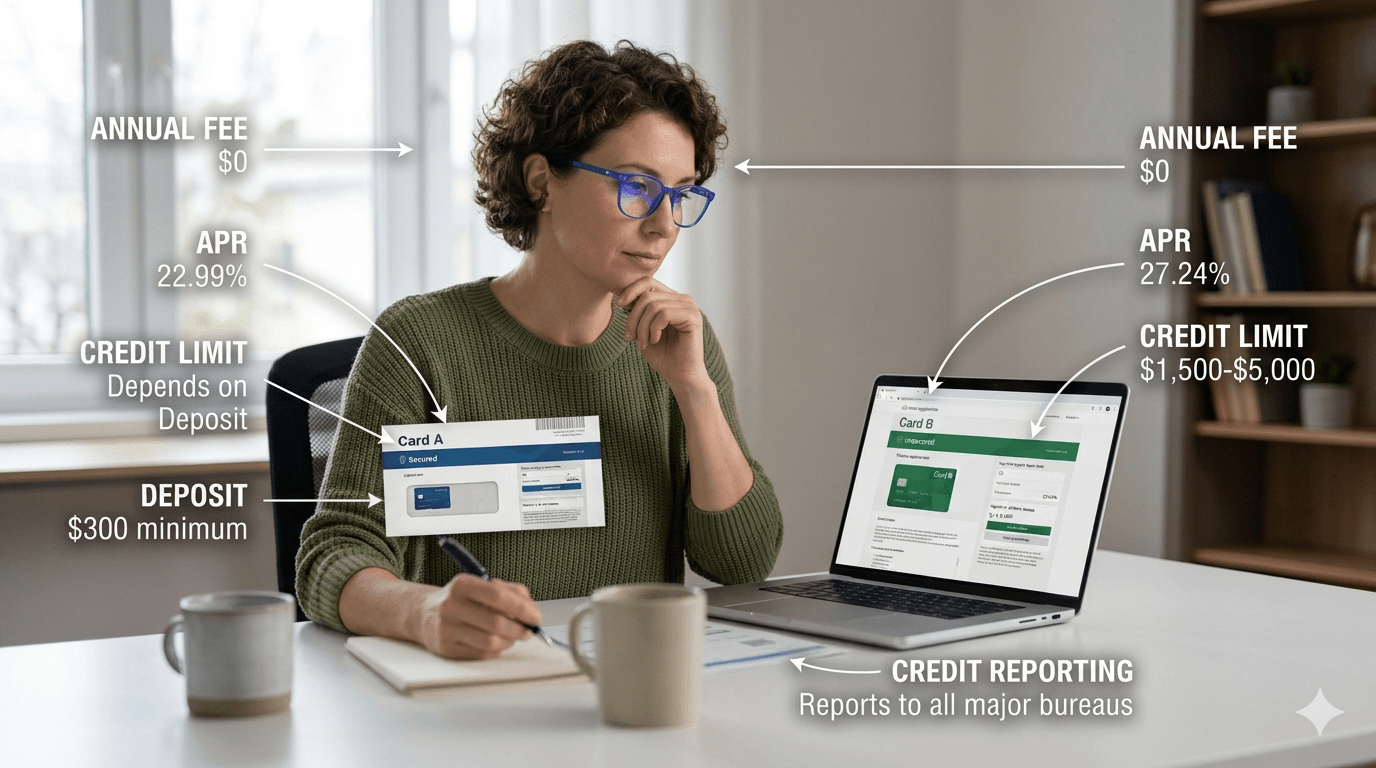
How to Choose a Credit Card for Bad Credit: Quick Answer
Choosing a credit card when you have bad credit shouldn't be based on which one is easiest to get approved for. Instead, compare offers across ten factors:
Total fees — not just the annual fee, but any monthly, processing, or one-time fees
APR — what it costs if you ever carry a balance
Security deposit requirements — if any, and whether it's refundable
Credit limit — how much room you'll actually have to spend
Credit-bureau reporting — whether the account will actually help build your credit history
Payment terms — due dates, minimum payments, and what happens if you're late
Rewards or features — genuinely useful, but rarely the deciding factor
Issuer requirements — what the issuer expects from you to open and keep the account
Long-term value — whether the card is still worth having a year or two from now
Fit for your actual financial situation — not just your credit score, but your budget and goals
The rest of this guide breaks each of these down into something you can actually use.
Know Your Credit Situation Before Applying
Before comparing any card offers, take stock of where you actually stand. You don't need a perfect picture — a rough sense of the following is enough to narrow your options meaningfully:
Your approximate credit score range (even a recent free score estimate is useful)
Whether you have any established credit history at all, or a thin file with little or no history
Any recent late or missed payments, and how recent they are
Existing credit accounts and their current balances
How many credit applications you've made recently
Any outstanding debt that would affect your ability to make new payments
This matters because different card types are built for different starting points. Someone with a thin file (little to no credit history) is often evaluated differently than someone with a damaged file (negative marks from past missed payments). Knowing which situation describes you helps you skip offers that aren't realistically designed for your profile, rather than applying broadly and hoping.
Decide What You Are Trying to Accomplish
Not everyone with bad credit wants the same thing from a credit card, and the "right" choice depends heavily on your actual goal. Before comparing offers, get specific about which of these describes you:
Establishing credit — you have little or no credit history and need to start building one
Rebuilding damaged credit — you have negative marks (late payments, a past default, or similar) you're working to offset over time
Getting a usable payment method — you need a card mainly for practical spending, not credit strategy
Avoiding a security deposit — you don't have cash available to tie up, so unsecured options matter more to you
Minimizing fees — cost control is your top priority over any other feature
Earning some rewards — you want a card that gives something back, as a secondary consideration
Transitioning toward better credit products — you're treating this card as a stepping stone, not a long-term hold
Different objectives point toward different trade-offs. Someone minimizing fees might accept a smaller credit limit. Someone rebuilding credit after a specific setback might prioritize an issuer with a track record of consistent reporting over a card with slightly lower fees. Naming your actual goal before you start comparing prevents you from getting pulled toward whichever offer has the flashiest marketing.
Secured or Unsecured: Which Structure Fits?
One of the first structural decisions you'll face is whether to consider a secured or unsecured card.
Secured cards typically require a refundable cash security deposit, which usually sets or backs your credit limit. Unsecured cards don't require that deposit — but they often make up for the lack of collateral with higher fees, a higher APR, or both.
Neither structure is universally better. A secured card can offer a lower-cost path to building credit if you have the cash for a deposit and don't mind it being tied up temporarily. An unsecured card can make sense if you'd rather not commit cash upfront and are comfortable with a different fee structure in exchange. For a full breakdown of how these two structures actually differ — including how deposits work, how limits are set, and what happens to your deposit over time — see our guide to secured and unsecured credit cards.
Compare the Total Cost — Not Just the APR
This is one of the most common mistakes people make: focusing entirely on APR while missing fees that matter more in practice, especially for someone who plans to pay their balance in full each month.
Break total cost into three categories:
Upfront cost — anything you pay before or at account opening: a security deposit, a one-time processing or application fee, or an initial account-opening fee some issuers charge separately from the annual fee.
Recurring cost — anything charged on a regular schedule regardless of how you use the card: an annual fee, a monthly maintenance fee, or other periodic charges.
Potential interest cost — what you'd pay only if you carry a balance, driven by the APR.
Here's why separating these matters. Hypothetical example (not based on any specific card's actual terms): imagine a card with a $50 one-time processing fee, a $75 annual fee, and a $6.50 monthly maintenance fee starting in year two. Even if that card charges $0 in interest — because the balance is paid in full every month — the cardholder would still spend $125 in the first year and roughly $153 in year two, purely in fees, before making a single purchase. Meanwhile, a different card with no processing fee and no annual fee, but a higher APR, could cost that same cardholder nothing at all over the same period — if they never carry a balance. The APR alone would have made the second card look "worse," but the total cost tells a different story for someone who pays in full.
The lesson: calculate what you'd actually pay under your realistic usage pattern, not just which single number looks lowest.
Understand the APR Before Applying
APR (Annual Percentage Rate) represents the yearly cost of borrowing if you carry a balance from one billing cycle to the next. It matters most in exactly that scenario — carrying a balance — and matters far less if you consistently pay your statement in full.
A few things worth understanding at a beginner level:
Variable APR can change over time, typically tied to a benchmark interest rate; fixed APR stays the same unless the issuer changes it under applicable terms.
APR compounds on any balance you carry, meaning the longer a balance sits, the more it costs — this is why even a "high APR but no fees" card can end up expensive for someone who occasionally carries a balance, even briefly.
APR should never be evaluated in isolation. A card with a lower APR but higher recurring fees isn't automatically the cheaper option — see the total-cost comparison above.
Carrying a balance is not necessary to build credit. Consistent on-time payments and reasonable utilization are what typically matter for your credit history — not paying interest. Carrying a balance specifically to "build credit faster" is a common misconception and generally just costs money without a corresponding credit benefit.
A future dedicated guide on this site will cover APR mechanics in more depth; for card-selection purposes, the summary above is enough to compare offers meaningfully.
Check the Credit Limit
Your starting credit limit affects more than just how much you can spend — it directly affects your credit utilization, which is a factor in most credit scoring models.
Credit utilization is your reported balance relative to your available credit. Hypothetical example: a $500 credit limit with a $100 balance works out to 20% utilization ($100 ÷ $500). A lower credit limit means smaller balances translate to higher utilization percentages — so a modest amount of everyday spending on a low-limit card can push utilization higher than the same spending would on a higher-limit card.
That said, the highest available credit limit isn't automatically the best choice. A higher limit paired with weaker terms elsewhere (higher fees, a higher APR, inconsistent reporting) isn't a better overall offer just because the number is bigger. And importantly: never assume a specific credit limit before you're actually approved, unless an issuer explicitly guarantees one in its current terms — advertised limits are often described as "up to" a maximum, not a guaranteed starting point.
Verify Credit-Bureau Reporting
If part of your goal is building or rebuilding credit, this is one of the most important things to confirm before applying — and one of the easiest to overlook.
Not every card reports identically. Before applying, check:
Whether the issuer reports account activity to the credit bureaus at all. This should not be assumed.
Which bureaus receive reports. Some issuers report to all three major bureaus (Experian, Equifax, and TransUnion); others may report to fewer. This affects how broadly your payment history shows up.
Whether reporting is consistent. Even among issuers that generally report, practices can vary by account type or change over time.
Don't assume every credit card reports to all three bureaus — that's not a safe universal claim, and it's worth confirming directly in the issuer's current disclosures before you apply, not after. For more on how reporting fits into a broader credit-building strategy, see our guide to using credit cards to build credit.
Look at the Payment Terms
Beyond fees and APR, the practical mechanics of how and when you pay matter for both your budget and your credit history.
Before applying, understand:
Due dates — when your payment is due each cycle, and how much advance notice your statement provides
Minimum payments — the smallest amount you can pay without being considered late (though paying only the minimum typically means carrying — and paying interest on — the remainder)
Statement balance — the total you'd need to pay to avoid interest charges, where a grace period applies
Late-payment consequences — potential fees, a possible APR increase, and the likelihood that a late payment gets reported to the credit bureaus
Autopay and reminders — whether the issuer offers automatic payments or alerts, which can reduce the risk of an accidental missed payment
Grace periods — many cards offer a window between your statement date and due date during which new purchases don't accrue interest if you pay the statement balance in full; terms vary by issuer
The single most important habit here: pay on time, every time. Late payments can be reported to the credit bureaus and can meaningfully set back the exact goal — building or rebuilding credit — that likely motivated the card application in the first place. Where feasible and consistent with your card's terms, paying your statement balance in full each month is also the most reliable way to avoid purchase interest entirely.
Do Rewards Matter When You Have Bad Credit?
Rewards can be genuinely attractive, and there's nothing wrong with wanting a card that gives something back. But when you're evaluating a card aimed at bad or rebuilding credit, rewards shouldn't be your first filter. A reasonable priority order looks like this:
Affordability — can you comfortably manage the required payments and fees?
Payment terms — are the due dates, grace period, and minimum payment structure workable for you?
Fees — total upfront and recurring cost
Credit reporting — will this account actually help your credit history?
APR — what happens if you ever carry a balance?
Credit limit — how much usable room will you have?
Rewards — a genuine plus, but last on the list for a reason
The reason rewards rank last isn't that they don't matter — it's that a modest rewards rate rarely offsets a card with high recurring fees. A card offering, say, 1% back on some purchases while charging a substantial monthly maintenance fee can easily cost more overall than a no-rewards card with a cleaner fee structure. Rewards are a legitimate tiebreaker between two cards that are otherwise comparable on cost and terms — not a reason to overlook cost differences in the first place.
Read the Fine Print for Fees and Restrictions
Before applying for any card, make a habit of reading through the issuer's current pricing and terms document, not just the marketing page. Specifically look for:
Annual fee
Monthly maintenance fee
Processing or application fee
Penalty fees (late payment, returned payment)
APR (and whether it's fixed or variable)
Security deposit and minimum deposit amount, if applicable
Credit limit language (guaranteed vs. "up to")
Foreign transaction fees
Cash advance fees
Late-payment rules and how they affect your account
Upgrade or graduation rules, if the issuer offers any
Account closure rules, including what happens to any deposit or remaining balance
This isn't a formality. Marketing pages highlight the most attractive terms; the pricing and terms document is where the complete picture lives. Reading it before applying — not after — is the single most reliable way to avoid an unpleasant surprise later.
Watch Out for High-Cost Credit Cards
Some card offers combine features in ways that should prompt extra scrutiny before applying. Warning signs worth taking seriously include:
Multiple recurring fees stacked on top of each other (for example, both a high annual fee and a separate monthly fee)
A large upfront fee relative to the credit limit you're likely to receive
A low credit limit paired with high fees, which can mean fees consume a substantial share of your available credit before you've spent anything
Unclear or hard-to-find pricing information
An APR notably higher than typical ranges for similar products
Vague or undocumented upgrade and graduation policies
Marketing that emphasizes urgency ("apply now," "limited time") over clear terms
None of this means a specific card is automatically a poor choice — plenty of cards aimed at rebuilding credit carry higher costs than mainstream products simply because of the risk profile involved. The point isn't to avoid every card with a fee; it's to make sure you can clearly see and evaluate what you're paying for, and that the cost is proportionate to what you're getting.
Compare the Card's Long-Term Value
The cheapest card today isn't necessarily the best card to hold for the next few years. Before applying, ask:
Will this card still be useful to me once my credit situation improves?
Are the ongoing fees reasonable for what the card provides?
Does it report credit activity in a way that actually supports my goals?
Am I likely to eventually qualify for stronger credit products?
Does this issuer offer any kind of upgrade or graduation path to a better card or lower fees?
Will I still want this specific account a year or two from now, or is it purely a short-term stepping stone?
It's worth being clear here: not every issuer offers a graduation or upgrade path, and even where one exists, it's not guaranteed for any individual cardholder — policies and eligibility criteria vary by issuer and can change. Don't apply for a card assuming an upgrade will happen; treat any upgrade path as a possible bonus, not a plan.
When a Secured Card May Make Sense
A secured card may be worth considering if:
You're able to provide the required security deposit without straining your budget
You'd prefer a collateral-backed structure, which can sometimes come with a more straightforward fee profile than fee-funded unsecured alternatives
You've had difficulty qualifying for unsecured products in the past
Your main goal is building a consistent, positive payment history over time, and you're comfortable with the deposit as the trade-off
Approval requirements vary by issuer even for secured cards — a deposit alone doesn't guarantee approval. If you want a deeper look at how secured cards work structurally, including how deposits and limits typically relate, our guide to secured and unsecured credit cards covers that in full.
When an Unsecured Card May Make Sense
An unsecured card may be worth considering if:
You don't have cash available (or don't want to tie up cash) for a security deposit
You're able to qualify for terms you consider reasonable given your situation
Preserving your available cash matters more to you right now than getting the lowest possible fees
But it's worth repeating plainly: unsecured does not automatically mean better. Some unsecured products aimed at bad credit carry higher annual fees, processing fees, or monthly charges specifically because they don't have a deposit to fall back on as collateral. Skipping the deposit isn't free — you're often paying for that flexibility somewhere else in the fee structure, which is exactly why the total-cost comparison earlier in this guide matters more than the secured-vs-unsecured label alone.
How to Compare Two Credit Cards Side by Side
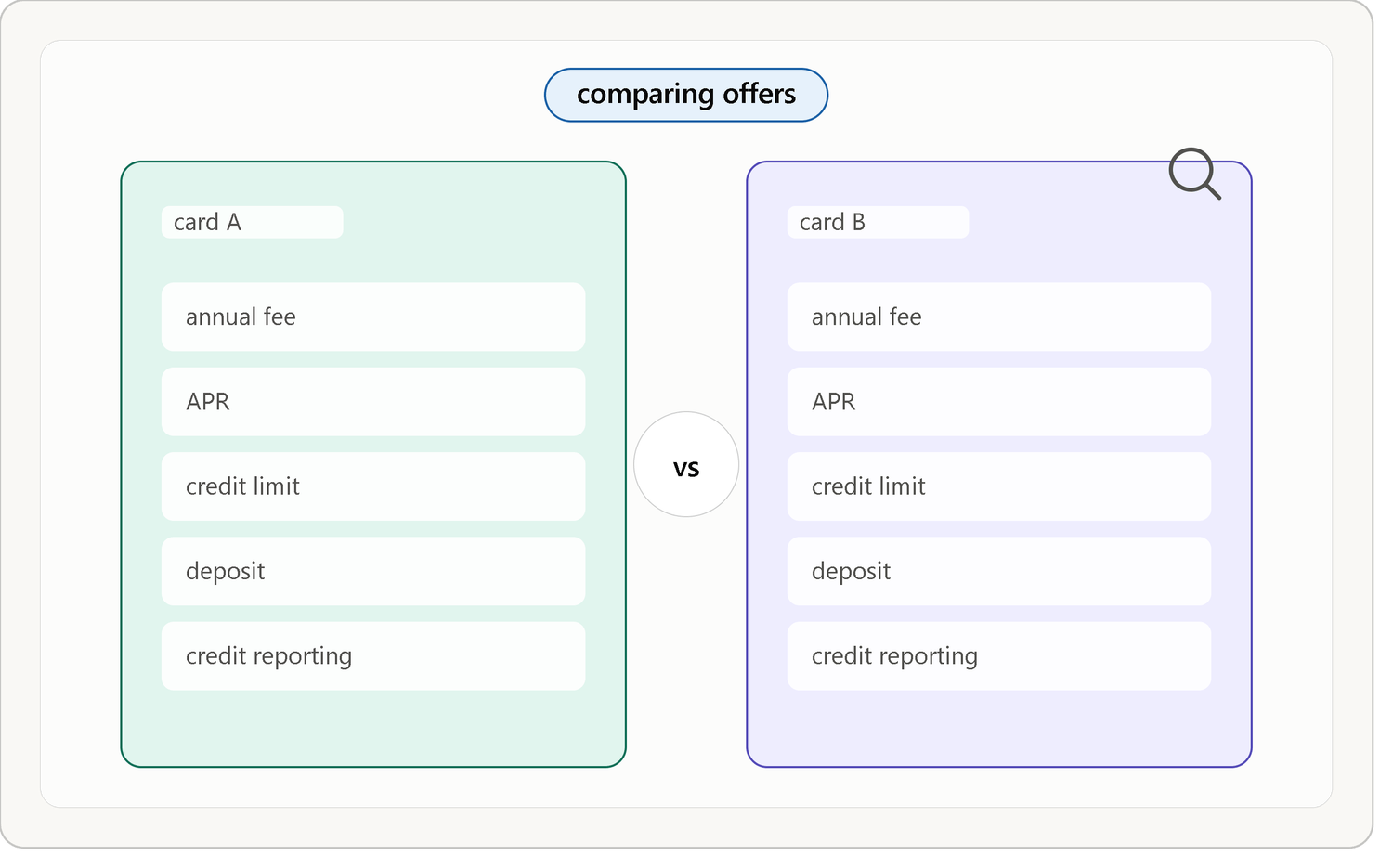
Once you have two or more real offers in front of you, use a structured comparison rather than an impression-based one. This table format works for any two cards, regardless of issuer:
| Feature | 💳 Card A | 💳 Card B | 💡 What to Consider |
|---|---|---|---|
| Annual fee | Compare against Card's total first-year cost, not in isolation | ||
| Monthly fee | Multiply by 12 to see the real annual impact | ||
| APR | Matters most if you might carry a balance | ||
| Security deposit | Refundable? Under what conditions? | ||
| Credit limit | Guaranteed or "up to"? | ||
| Credit reporting | Which bureaus, and how consistently? | ||
| Rewards | Realistic value given your actual spending | ||
| Late fee | What triggers it, and how large is it? | ||
| Foreign transaction fee | Relevant only if you'll use the card abroad | ||
| Upgrade path | Documented policy or undefined? | ||
| Other costs | Processing fees, cash advance fees, etc. |
To use this table: fill in each row with the actual terms from each offer's current pricing and terms document — not the marketing page. Where a term isn't clearly stated, leave it blank and treat that as a red flag worth investigating before applying, rather than assuming a favorable default.
A Simple 7-Step Credit Card Selection Process
Know your credit situation. Get a rough sense of your score range, existing accounts, and recent payment history.
Define your goal. Establishing credit, rebuilding it, minimizing cost, or something else — name it specifically.
Decide whether secured or unsecured fits better. Based on whether you have deposit funds available and which trade-offs you're comfortable with.
Compare total fees. Upfront, recurring, and potential interest cost — not just the number that's advertised loudest.
Check APR and payment terms. Understand what happens if you carry a balance, and confirm due dates and grace-period rules.
Verify credit reporting. Confirm which bureaus receive reports and how consistently, directly from the issuer's current disclosures.
Review the issuer's current terms before applying. Read the actual pricing and terms document, not just the offer summary, immediately before you apply — terms can change, and the version you saw last month may not be current.
Examples From Credit Cards We Have Reviewed
To make this framework concrete, here's how a few different card structures illustrate the trade-offs above — not as recommendations, just as examples of the process in action.
The Milestone Mastercard is a useful example of an unsecured credit card aimed at damaged or limited credit: no security deposit, but a fee structure that needs to be weighed carefully against the credit limit it provides. See our Milestone Mastercard review for the specific terms as of our last check.
The FIT Mastercard illustrates why examining a fee structure closely matters — some unsecured cards in this category collect a portion of their cost before the account is even usable, which changes the total-cost math compared with a card that deducts fees from the credit line itself. Our FIT Mastercard review breaks down that structure in detail.
Yendo represents a different structural category entirely: a card secured by a vehicle rather than a cash deposit. That's a meaningfully different kind of collateral, with its own risks worth understanding before applying — losing access to a vehicle is a different consequence than losing a refundable cash deposit. See our Yendo credit card review for specifics.
The Ross Credit Card is a useful example of a retail/store-card structure, where rewards are tied to a single retailer rather than usable broadly — a good illustration of why "rewards" should be evaluated in the context of your actual spending, not just the advertised rate. Our Ross credit card review covers the details.
For a broader look at the full range of card types available to people with bad credit, see our guide to credit cards for bad credit.
Common Mistakes People Make When Choosing a Card With Bad Credit
Choosing only based on approval odds, without comparing what the card actually costs
Ignoring annual fees because the monthly cost looks small in isolation
Ignoring monthly fees, which often add up to more than the annual fee over a year
Looking only at APR while missing fees that matter more for someone who pays in full
Focusing too heavily on rewards before confirming the card is actually affordable
Not checking credit reporting, and assuming every card reports the same way
Applying for too many cards at once, which can generate multiple hard inquiries and doesn't improve approval odds
Ignoring the credit limit and how it interacts with utilization
Assuming "secured" means "prepaid" — a security deposit is refundable collateral, not a prepaid spending balance
Assuming "unsecured" automatically means better or cheaper without comparing actual fees
Carrying a balance unnecessarily, believing it will build credit faster — it typically doesn't, and it costs money
Not reading the current pricing and terms document before applying
Ignoring long-term value and only evaluating the card for its first year
Assuming current terms can never change — issuer pricing, fees, and policies are subject to change over time
Should You Apply for a Credit Card With Bad Credit?
There's no universal yes or no answer — it depends on your specific situation.
A credit card may make sense if:
You can comfortably afford the required payments and fees
The fees are reasonable relative to what the card provides
The account genuinely fits your stated goal (establishing, rebuilding, or simply having a usable payment method)
The issuer's reporting practices align with what you're trying to accomplish
You've read and understood the current terms before applying
A credit card may not be the right move right now if:
You can't realistically afford the required payments
The fees would strain your budget
Taking on a new account would worsen, rather than improve, your overall financial situation
This guide is educational and isn't a substitute for individualized financial advice based on your specific circumstances.
FAQ
How do I choose a credit card with bad credit?
Compare total fees, APR, security deposit requirements, credit limit, credit-bureau reporting, and payment terms — not just approval odds. Use a side-by-side comparison and read each issuer's current pricing and terms before applying.
What should I look for in a credit card if my credit is poor?
Start with affordability: total fees (upfront and recurring), the APR, and whether the credit limit and deposit requirements fit your budget. Then confirm the issuer reports to the credit bureaus if credit-building is your goal.
Is a secured credit card better for bad credit?
Not universally. Secured cards require a refundable deposit but sometimes offer a more straightforward fee structure; unsecured cards skip the deposit but may carry higher fees. The better fit depends on whether you have deposit funds available and which trade-offs suit your situation.
Should I choose a secured or unsecured credit card?
It depends on your priorities — cash availability, comfort with a deposit, and the specific fees each option carries. See our secured versus unsecured comparison for a full breakdown of the structural differences.
What fees should I watch for?
Annual fees, monthly maintenance fees, processing or application fees, late fees, foreign transaction fees, and cash advance fees. Add them up against your realistic usage pattern rather than looking at any single fee in isolation.
Does APR matter if I pay my balance in full?
Less than it would if you carried a balance, but it's still worth knowing in case your circumstances change. If you consistently pay in full, recurring fees typically matter more to your total cost than the APR does.
Does a credit card for bad credit build credit?
It can, but only if the issuer reports your activity to the credit bureaus and you manage the account responsibly — consistent on-time payments and reasonable utilization. Not every card reports identically, so this is worth confirming directly with the issuer before applying.
How important is the credit limit?
It affects your credit utilization, which is a factor in most credit scoring models. A very low limit can make normal spending look like high utilization. That said, the highest available limit isn't automatically the best choice if the card's other terms are weaker.
Should I prioritize rewards or low fees?
Generally, low fees and manageable terms should come first. Rewards are a reasonable tiebreaker between two otherwise comparable cards, but a modest rewards rate rarely offsets high recurring fees.
How many credit cards should I apply for?
Generally, apply thoughtfully rather than broadly. Multiple applications in a short period can generate multiple hard inquiries, and opening accounts you don't need doesn't inherently help your credit-building goals.
Should I check credit-bureau reporting before applying?
Yes, if building or rebuilding credit is part of your goal. Confirm which bureaus the issuer reports to, since this isn't consistent across every card.
What should I read before applying for a credit card?
The issuer's current pricing and terms document — not just the marketing page or offer summary. This is where complete fee, APR, and policy details actually live, and it's the best way to avoid surprises after you're approved.
Bottom Line
Choosing a credit card with bad credit isn't about finding the one that's easiest to get approved for — it's about comparing total cost, APR, credit limit, credit-bureau reporting, payment terms, and long-term usefulness against your specific goal and financial situation. A card that's simple to qualify for isn't automatically a good fit if its fees are high relative to its credit limit, or if it doesn't report your activity to the bureaus at all. Use the comparison table and 7-step process in this guide on any offer you're considering — including ones you find elsewhere — and always review the issuer's current pricing and terms directly before applying, since terms can and do change.