
Can You Pay a Mortgage With a Credit Card?
Usually not directly. Most mortgage servicers do not accept credit cards. You can pay indirectly through a third-party bill-payment service, which publishers report charges about 2.9% to 2.99% and accepts only certain card networks for mortgages, or by taking a cash advance, which typically costs more. Either way, the cost often outweighs the rewards.
Last reviewed November 11, 2026. This article is educational and is not financial or legal advice.
Can you pay a mortgage with a credit card? Usually not directly. Most mortgage servicers do not accept credit cards, so there is rarely a card option on the payment page. There are indirect routes. A third-party bill-payment service can charge your card and send the money to your servicer, for a fee that publishers currently report at about 2.9% to 2.99%. A cash advance turns your card's credit line into cash, usually at a higher cost. A few rewards programs, such as Bilt's, let you earn points on mortgage payments without charging the mortgage to a card at all. For most households, the fee or the interest outweighs the rewards. The exception is a card you pay off in full, where a bonus or promotion is worth more than the cost.
How to Read This Article
You will see three kinds of statements, and we try to keep them apart.
Reported facts come from issuer pages, payment-service documentation and published articles we reviewed on November 11, 2026. We say who reported them. Fees and eligibility change often, so confirm before you pay.
Hypothetical examples use made-up fee rates, APRs and bonuses so you can see how the arithmetic works. They are labeled and are not quotes from any provider.
Editorial interpretation is our judgment, and we mark it as such.
We have not tested any of these services ourselves, and nothing here is a recommendation of a specific card or company.
Can You Pay Your Mortgage Directly With a Credit Card?
For most borrowers, no. The company you send your payment to is your mortgage servicer. It collects the money, then applies it to principal, interest and, often, an escrow account for taxes and insurance. Common ways to pay are an automatic bank draft (ACH), online bill pay from your bank, a debit card payment online or by phone, or a check. Credit cards are rarely on that list.
Publishers give a few consistent reasons.
Processing cost. Accepting cards costs the receiver a percentage of every payment. The Points Guy says banks and landlords would lose roughly 2% to 3% of a payment to interchange fees if they accepted cards without a surcharge. CNBC Select puts card transaction fees as high as 3.5%.
Secured debt paid with unsecured debt. A mortgage is backed by your home. Zillow and CNBC Select both note that paying it with a credit card swaps a secured loan for unsecured card debt, which raises risk for you and the lender.
Debt transfer. Rocket Mortgage points out that charging the payment moves the debt from one source to another, and that relying on a card because you lack the cash could end in default.
Payment networks and card issuers also matter. Visa, Mastercard, Discover and American Express set rules for what kinds of payments their cards may fund, and each issuer adds its own rules. Plastiq's own eligibility guidance, though an older page, says most card issuers prohibit paying debt with other debt, and that mortgage payments by Mastercard and Discover are a notable exception. We explain the issuer and network differences in more detail below.
If a servicer does accept cards, expect a convenience fee. Ask for the exact amount and whether the charge could be treated as a cash advance by your card issuer. We did not verify card-acceptance policies for any individual servicer.
How to Pay a Mortgage With a Credit Card
There are three realistic ways to get a card involved, and they work in very different ways. It helps to know four terms first.
A purchase is an ordinary card charge. It usually has a grace period, so you can avoid interest by paying in full.
A cash advance is a withdrawal of cash against your credit line. It typically has its own fee and APR, and interest starts at once. Our guide to how credit card interest works explains grace periods and how cash advances differ.
A balance transfer moves debt from one account to another, usually with its own fee and promotional terms.
A third-party payment is a purchase you make with a bill-payment company. That company then pays your servicer. Your issuer may code it as a purchase or, in some cases, as something closer to cash.
| Route | Availability | Main limitations | Potential fees | Main risks |
|---|---|---|---|---|
| Direct card payment to your servicer | Uncommon. Most servicers do not accept credit cards. Check your servicer's payment page or call. | The servicer decides whether to accept cards at all. Issuer and card-network rules can also apply. | If a servicer accepts cards, it may add a convenience fee. We did not verify any specific servicer's fee. | A large new balance on the card. Interest if the card is not paid in full by its due date. |
| Third-party bill-payment service (for example, Plastiq) | Available. Eligibility depends on card network, card issuer and the type of payee. | Publishers report mortgage payments are limited to certain networks (mostly Mastercard and Discover). Some issuers block these payments. See Table 4. | Publishers report a processing fee of about 2.9% to 2.99%, plus a delivery fee (reported as $0.99 for ACH and $1.49 for check). Promotions change the fee. | Delivery delays that cause a late mortgage payment. Issuer may treat the charge as a cash advance. Card interest if not paid in full. |
| Cash advance, then pay by bank transfer, debit or check | Most cards allow cash advances, but only up to a separate cash-advance limit. | The cash-advance limit is often a fraction of the credit limit. The cash must still reach your servicer by another method. | Commonly the greater of $10 or about 5% of the advance, per published issuer terms. Interest at a separate, usually higher, cash-advance APR. | No grace period, so interest starts right away. Usually the most expensive route. |
| Rewards platform that pays from your bank account (for example, Bilt) | Available to people who hold the program's card and use its housing-payments feature. | Not a card charge. Reports say the mortgage payment is pulled from your bank account. Program terms are complex and have changed. | Bilt states there is no fee to earn points on housing payments. Other conditions apply. | Gives you no extra time to pay and no borrowing. Rules and point values can change. |
Reported terms come from the publishers and issuer pages listed in the sources section and were checked on November 11, 2026. Fees and eligibility change often. Confirm with the service and your card issuer before paying.
Using a Third-Party Payment Service
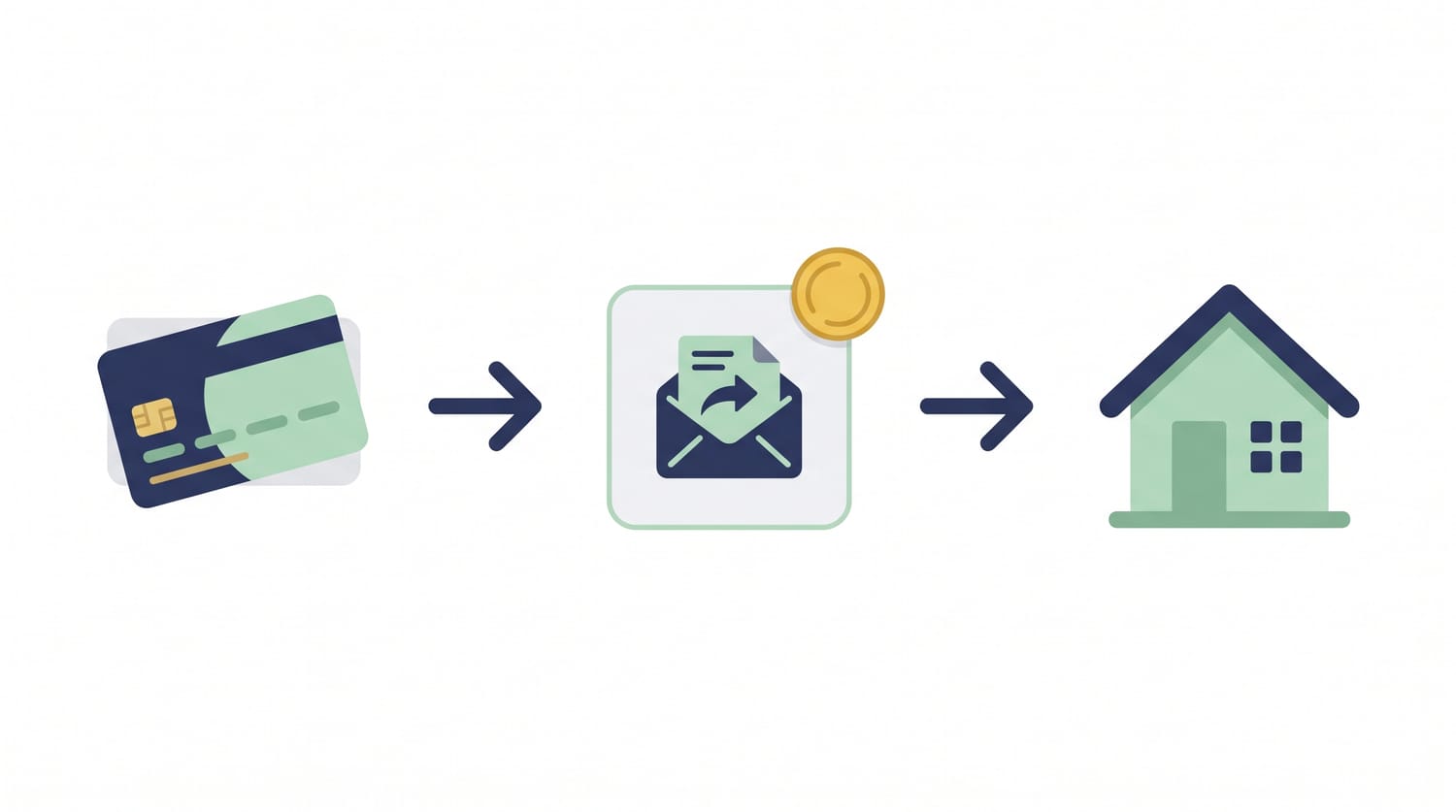
This is the most common route. Plastiq is the service most publishers discuss for mortgages. The steps are similar across services.
Create an account and add the card you want to use.
Enter your servicer's payment details and the amount.
Review the fee and the estimated delivery date before you confirm. Reviewers say Plastiq shows both before you submit.
The service charges your card and sends the money to your servicer by ACH, check or wire.
Pay the card in full by its due date.
What publishers report about cost: Wise and Yahoo Finance describe a processing fee of about 2.9%. The Points Guy, NerdWallet and Upgraded Points describe about 2.99%. Yahoo Finance also reports a delivery fee that depends on the method, for example $0.99 for an ACH payment. We could not open Plastiq's own fee page this session, so use these as reported numbers and rely on the figure the service shows at checkout. The Points Guy notes that Plastiq runs occasional promotions that lower the fee.
Timing is easy to overlook. The Points Guy advises allowing at least a full week for a mailed check to reach the servicer. A card payment that arrives after your grace period can mean a late mortgage payment even though you started it on time.
Which cards work depends on the network and the issuer, and the reports conflict in places. Table 4 collects what we found.
| Card type or issuer | What reporting says | Effect on a mortgage payment | How strongly verified |
|---|---|---|---|
| Mastercard (credit) | Plastiq's eligibility chart and several 2025 to 2026 publishers list Mastercard as accepted for mortgage payments. | Generally the most workable network for third-party mortgage payments. | Consistent across sources. Plastiq's own chart is an older page. |
| Discover (credit) | Listed alongside Mastercard for mortgage payments by Plastiq's chart and by publishers. | Generally workable through a third-party service. | Consistent across sources. |
| Diners Club | Named as accepted for mortgage payments by The Points Guy (updated October 21, 2026) and Upgraded Points. Not on Plastiq's older chart. | May work. Confirm at checkout. | Partly verified. Sources differ. |
| Visa (credit) | Multiple publishers report Plastiq does not accept Visa credit cards for mortgage payments. | Likely blocked for mortgage payments on Plastiq. | Consistent across sources. |
| Visa (debit) | AwardWallet (September 2025) says Visa debit is accepted for mortgages on Plastiq, while others only discuss credit. Not a credit-card route. | Possible, but it is not credit-card borrowing. | Conflicting. Verify before relying on it. |
| American Express | Plastiq's chart and publishers say Amex is not accepted for mortgage payments. | Likely blocked for mortgage payments through a third-party service. | Consistent across sources. |
| Capital One | Travel Freely (about 25 days old) says personal Capital One cards cannot be used on Plastiq, and business cards are excluded for mortgages. | Likely blocked. | One recent source. Verify. |
| U.S. Bank | Travel Freely says U.S. Bank cards cannot pay a mortgage on Plastiq. | Likely blocked. | One recent source. Verify. |
| Bank of America | NerdWallet says Bank of America credit cards cannot be used to pay a mortgage. | Likely blocked. | One publisher. Verify with the issuer. |
| Chase | Wise's Plastiq review says Chase may treat some transactions as cash-like, which could add fees or interest. | A charge could be coded as a cash advance. | One publisher. Verify with the issuer. |
Based on published reports, not on network rulebooks. Card networks and issuers change what they allow without notice. We could not open Plastiq's current eligibility page, so treat this as a starting point and check at checkout.
Using a Specialized Mortgage Payment Arrangement
A few rewards programs are built around housing payments. The best known is Bilt, which launched a new card lineup in February 2026.
Bilt says its cardholders earn points on rent and mortgage payments with no transaction fee. Its program page describes up to 1.25 points per dollar under a housing-only option, and up to 1 point per dollar when you use Bilt Cash to unlock points. Bilt also says its points do not expire.
The part many articles blur: reports from The Points Guy and NextCard say mortgage payments through Bilt are drawn from your bank account, and NerdWallet says they do not count against the card's credit limit. In other words, you are not borrowing from the card to pay the mortgage. You are earning points on a payment you fund yourself. That means no extra time to pay, no float and no card interest on the mortgage.
A recent Points Guy review adds that if you pay your mortgage through Bilt without a Bilt card, you earn much less. It reports 100 points for an ACH payment, 250 for a debit card payment and 1 point per $2 with a non-Bilt Mastercard, excluding fees.
NerdWallet also mentions a card called Made as a niche option for earning points on mortgage payments. We did not verify its terms, so we do not describe them. Program rules, point values and caps can change, so read the current terms before you rely on any of them.
Using a Cash Advance
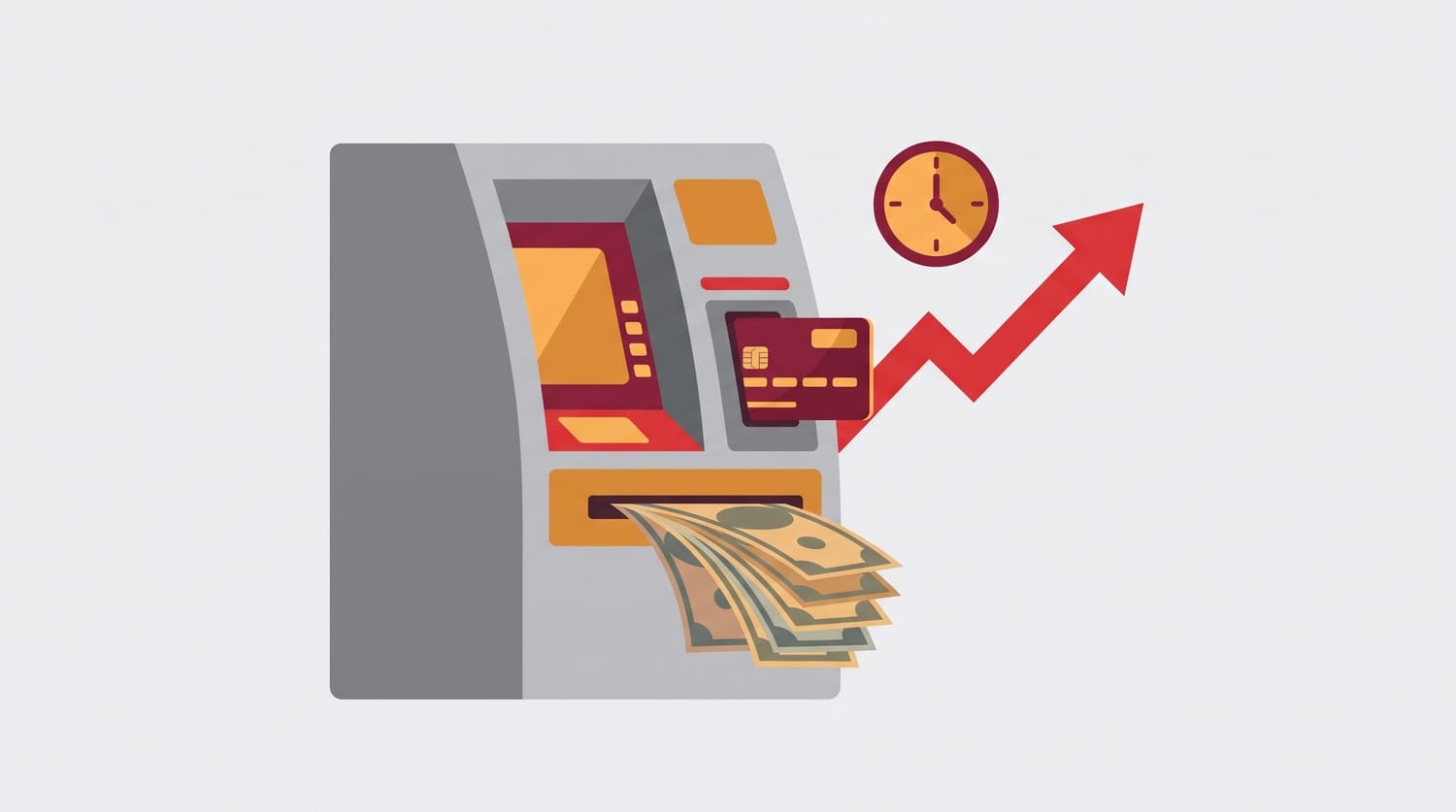
You can take cash from your card at an ATM or by another cash-advance method, put it in your bank account, and pay your servicer by ACH, debit or check. Publishers such as CardRatings and Fox Business describe this as an option and caution that it is costly.
The costs and the lack of a grace period are covered in their own section below. In short, it is almost always the most expensive way to put a mortgage payment on a card.
Other Possible Payment Methods
Business-property platforms. One publisher, Upgraded Points, names Melio for mortgages on business property, using a business card. We could not verify its mortgage support or fees, so check directly.
Convenience or balance-transfer checks. Issuers often treat these like cash advances or balance transfers with their own fees. Read the offer terms first.
Prepaid cards, gift cards or money orders bought with a card. Several publishers mention these workarounds. We do not walk through them. Issuers may price them like cash, fees can stack, and Plastiq has tightened its rules on prepaid cards.
How Much Does It Cost to Pay a Mortgage With a Credit Card?
Costs fall into a few buckets. Which ones apply depends on the route.
Processing fee. A percentage of the payment, charged by the third-party service. Reported at about 2.9% to 2.99%.
Delivery fee. A small flat fee for how the money is sent.
Cash-advance fee. Published issuer terms commonly show the greater of $10 or about 5% of the advance. Your card agreement controls.
Interest. If you do not pay the statement balance in full by the due date, interest accrues at the purchase APR. For a cash advance, interest starts immediately at the cash-advance APR. how credit card interest works walks through the calculation.
Lost rewards. Some programs may exclude certain transactions. Ask your issuer.
Late costs. A delivery delay can turn into a late fee on your mortgage.
| Cost type | Applies to | How it is charged | Illustrative cost on $2,000 | When it hits |
|---|---|---|---|---|
| Processing fee | Third-party service | Percentage of the payment. Publishers report about 2.9% to 2.99% for credit cards. | 2.9% = $58.00. 2.99% = $59.80. | At payment, added to your card charge |
| Delivery fee | Third-party service | Flat fee that depends on delivery method. Reported as $0.99 for ACH and $1.49 for check. | $0.99 to $1.49 | At payment |
| Cash-advance fee | Cash advance | Commonly the greater of $10 or about 5% of the advance. Check your card agreement. | 5% = $100.00 | When the advance posts |
| Cash-advance interest | Cash advance | Separate APR, often higher than the purchase APR, with no grace period. Illustration uses a 30% APR on the advance plus fee. | 30 days: $51.78. 10 days: $17.26. | Daily, starting the day the advance posts |
| Purchase interest | Third-party service or direct card payment | Applies only if you do not pay the statement balance in full. Illustration uses a 24% APR on the payment plus a 2.9% fee for 30 days. | $40.60 | After the grace period is lost or missed |
| Lost or reduced rewards | Any card route | Some issuers or programs may exclude certain transactions from rewards. Confirm with your issuer. | Varies. Not calculated. | When rewards post |
| Late-payment costs | Any route with a delivery delay | Late fees and possible reporting if the mortgage payment arrives late. Amounts vary by servicer and loan. | Varies. Not calculated. | If payment arrives after the grace period or due date |
Illustrations use hypothetical APRs and the reported fees named above. Interest is calculated as balance x APR / 365 x days. Your card agreement and the provider's checkout screen control the real numbers.

Example: What Would It Cost to Pay a $2,000 Mortgage With a Credit Card?
These are hypothetical fee rates, chosen to show how the math scales. They are not the charges of any particular provider, and actual fees vary.
On a $2,000 payment:
A 2% fee is $40.00, so $2,040.00 is charged to your card.
A 2.5% fee is $50.00, so $2,050.00 is charged.
A 3% fee is $60.00, so $2,060.00 is charged.
Over 12 monthly payments, those fees add up to $480, $600 and $720. At the reported rates of 2.9% and 2.99%, the fee is $58.00 and $59.80 per payment, or $696.00 and $717.60 a year.
The rule of thumb is simple. The reward you actually earn on the payment has to be larger than the fee percentage. Suppose, hypothetically, you used a card earning 2% back and the rewards applied only to the $2,000 mortgage amount. The reward would be $40. A 2% fee leaves you at $0. A 2.5% fee leaves you $10 behind, and a 3% fee leaves you $20 behind, before any delivery fee.
Points can change the picture, but only if you value them highly. The Points Guy gave one example: a $2,000 mortgage payment through Plastiq during a 2% promotion costs $40 in fees and earns points it valued at $76 using its April 2026 valuations. A points valuation is a publisher's estimate, and your own value from points may be lower.
Table 2 shows the fee and the total card charge for five payment sizes.
| Mortgage payment | Fee at 2% | Fee at 2.5% | Fee at 3% | Total charged to card at 2% | Total charged to card at 2.5% | Total charged to card at 3% |
|---|---|---|---|---|---|---|
| $1,000 | $20.00 | $25.00 | $30.00 | $1,020.00 | $1,025.00 | $1,030.00 |
| $1,500 | $30.00 | $37.50 | $45.00 | $1,530.00 | $1,537.50 | $1,545.00 |
| $2,000 | $40.00 | $50.00 | $60.00 | $2,040.00 | $2,050.00 | $2,060.00 |
| $2,500 | $50.00 | $62.50 | $75.00 | $2,550.00 | $2,562.50 | $2,575.00 |
| $3,000 | $60.00 | $75.00 | $90.00 | $3,060.00 | $3,075.00 | $3,090.00 |
Hypothetical fee rates for illustration. They are not a quote from any provider. Delivery fees, if any, are extra. Fee = payment x rate. Total = payment + fee.
Is Paying a Mortgage With a Credit Card Worth It?
For most people, our view is no. This part is editorial interpretation, based on the figures above.
Rewards. A mortgage payment is large and predictable, which makes it appealing for rewards. The fee has to be beaten, though. CreditCards.com notes that even the best flat-rate cards average about 1.5% to 2% back, which is below a 2.9% fee.
Welcome bonuses. This is the most defensible case. A large one-time payment can meet a spending requirement, and a bonus can be worth more than a single fee. The bonus must be real, the card must suit you for the long run, and you must pay it off in full. If you are weighing a new card for this reason, our page on how many credit cards you should have covers the trade-offs of adding accounts.
Processing fees. The fee is certain, while the reward is conditional. The fee is charged every time.
Interest. Mortgage interest rates are generally far below credit card APRs. If any part of the charge carries past the card's due date, you can end up paying the higher rate on a home-related expense. Our credit card payoff calculator can show how long a balance would take to clear.
Debt risk. If the card funds a payment you could not otherwise afford, the risk is serious. You would be replacing a secured loan with unsecured debt and a fee. Talk to your servicer first.
Available credit. A mortgage payment can use a large share of a card's limit. That reduces what is left for emergencies and can raise utilization.
Financial discipline. This strategy only works if the card is paid in full, on time, every time, and if you track the fee and the delivery date.
| Scenario | Might make sense if... | Probably does not if... | Illustrative math on a $2,000 payment |
|---|---|---|---|
| Meeting a welcome-bonus spending requirement | You would qualify for the bonus anyway, the bonus is worth clearly more than the fee, you pay the card in full, and the card suits you beyond the bonus. | You open a card only for the bonus, your limit is too low for the payment, or you cannot repay by the due date. | At a 2.5% fee ($50), a hypothetical $200 bonus nets $150 before any other cost. |
| Earning everyday rewards | A promotion or program brings the fee below your effective reward rate. | The fee is higher than the reward rate, which is the usual case. | A 2% reward ($40) against a reported 2.9% fee ($58) is a net loss of $18 a month. |
| Short timing gap before payday | You will certainly have cash to clear the card before the due date, and the fee is lower than the late costs you would otherwise face. | The cash may not arrive, or the delivery time could make the mortgage payment late. | Compare the fee ($58 at 2.9%) with your servicer's late fee. We could not verify typical late-fee amounts. |
| Carrying a balance | Rarely. This is the situation the interest guide warns about. | You expect to carry any part of the balance past the due date. | $2,058 at a 24% APR for 30 days adds $40.60 in interest on top of the $58.00 fee. |
| Covering a payment you cannot afford | Not recommended. Talk to your servicer first. | Your income does not cover the mortgage and the card would fund the gap. | Debt moves from a secured, lower-rate loan to a higher-rate card, with a fee on top. |
| Tight credit limit | The payment would use a modest share of your available credit. | The payment would push one card close to its limit. | $2,000 on a $10,000 limit is 20% of the limit. On a $4,000 limit it is 50%. |
| Cash advance as the funding source | Almost never. Cost is front-loaded by the fee and interest starts immediately. | You can use any other method. | 5% fee ($100.00) plus about $51.78 in 30 days of interest at a 30% APR is about $151.78. |
Hypothetical figures for education, not advice. APRs, bonuses and reward rates are assumptions. Interest uses balance x APR / 365 x days.
Can Paying Your Mortgage With a Credit Card Affect Your Credit Score?
It can, mainly through the card side. No outcome is guaranteed, and the effect depends on your full credit profile.
Utilization. Charging $2,000 raises that card's balance. On a $10,000 limit, that is 20% of the limit used by this charge alone. On a $4,000 limit, it is 50%. Issuers commonly report a balance tied to the statement closing date, so a large charge can appear on your report even if you pay it before the due date. The details are in our guide to the credit utilization ratio, so we will not repeat them here.
Payment reporting. Your servicer reports your mortgage payment history, and your card issuer reports the card. Paying the servicer through a card or a service does not change who reports what. If the payment arrives late, though, the late payment can affect the mortgage account. Late payments are generally reported once they are 30 or more days past due, but your servicer's rules control.
Hard inquiries. Using a payment service is not by itself a credit application. A hard inquiry can come from applying for a new card or, depending on the issuer, a credit-limit increase. This matters if you are opening a card for a bonus.
Cash-advance treatment. A cash advance increases your balance and utilization like any other balance. Interest then increases the balance further, because it starts accruing right away.
Paying a mortgage vs. charging a mortgage payment. Paying your mortgage on time is what the mortgage account reflects. Charging that payment to a card creates a new card balance that you must also manage. The two accounts are separate. Doing one well does not make up for doing the other poorly. For how card activity relates to credit history, see how credit cards build credit.
What Happens If You Use a Cash Advance to Pay Your Mortgage?
This is the most expensive route, and the cost shows up in several places.
Cash-advance fee. Published issuer terms commonly show the greater of $10 or about 5% of the advance. A 2026 secondary report lists Chase at that level. Check your own agreement.
Cash-advance APR. It is a separate rate, usually higher than the purchase APR. A secondary report citing a 2024 CFPB review of card agreements says about 30% is the most common rate. We did not review the CFPB's original document, so treat that as a reported figure.
Interest starts immediately. Experian, Capital One and Bankrate all say cash advances typically have no grace period. Paying the statement in full does not erase interest that has already built up.
Grace-period spillover. Mixing a cash-advance balance with purchases can complicate things. Extra payments above the minimum generally go to the highest-APR balance first, which is covered in our guide to credit card minimum payments.
Credit-limit restrictions. Cash advances usually have their own cap. PenFed says it is often 20% to 50% of the credit limit. A $2,000 payment may not fit on a lower-limit card.
Moving the cash. You then have to get the money to your servicer, which adds time and may involve ATM or bank limits.
Hypothetical example. A $2,000 advance with a 5% fee costs $100.00 up front, so you owe $2,100.00. At a 30% APR, 30 days of interest on that balance is about $51.78, for a total cost of $151.78 in the first month. If you repay it in 10 days, interest is about $17.26, for a total of $117.26. Even the quick repayment costs about twice what a 2.9% third-party fee would on the same payment.
Why Most Mortgage Lenders Do Not Accept Credit Cards
The reasons fall into two groups.
Economics. If interchange costs run 2% to 3% of a payment, as The Points Guy reports, a $2,000 mortgage payment would cost the receiver $40 to $60 each month, which is $480 to $720 a year for that one loan. Our interpretation is that servicers do not usually price their service to absorb a cost like that, though we did not research any servicer's fee structure.
Operations and risk. A card payment sits between the borrower, the servicer, the payment network and the card issuer. Each has its own rules and its own timing. Zillow and CNBC Select describe the larger worry: paying a loan secured by a home with unsecured credit raises the odds that a missed card payment leads to a missed mortgage payment. We would add that card payments can generally be disputed or reversed, which is an extra operational concern for a servicer. That last point is our inference and is not sourced.
Third-party services sidestep this by acting as the payer. As NerdWallet explains, the service sends your servicer an ordinary electronic payment or a check, so the servicer does not need to accept a card.
Alternatives to Paying a Mortgage With a Credit Card
If your goal is simply to pay your mortgage on time at the lowest cost, the usual options are better.
Bank-account payments. Automatic ACH drafts or online bill pay from your bank are the standard routes that Experian and Zillow describe. Ask your servicer whether any fee applies.
Debit cards where supported. Zillow lists paying online or by phone with a debit card as an option. Ask whether your servicer charges a fee for it.
Check by mail. It works, but allow time for delivery.
Official payment arrangements. If you may miss a payment, contact your servicer before you do. The CFPB says servicers may offer options such as a loan modification, a repayment plan or forbearance, and that you may need to submit a mortgage-assistance application.
Free housing counseling. HUD-approved housing counselors can help you understand your options at little or no cost. The CFPB lists the HOPE Hotline at (888) 995-HOPE (4673) and says you should not pay anyone upfront for foreclosure help.
We do not recommend using card debt, cash advances or short-term borrowing to cover a mortgage payment you cannot afford. That usually adds cost and risk without fixing the shortfall.
Mistakes to Avoid When Paying a Mortgage With a Credit Card
Assuming your card will work. Network and issuer rules differ. Check eligibility before you schedule anything.
Assuming the fee is the same everywhere. Fees and promotions change. Read the total at checkout.
Ignoring the delivery date. The date that matters is when the servicer receives the money, not when you click submit.
Not paying the card in full. One month of carried balance can wipe out any reward.
Not checking how your issuer codes the transaction. A cash-advance classification changes the whole cost.
Opening a card only for the bonus. Make sure the limit, the utilization and the card's long-term fit all work for you.
Forgetting the annual total. A fee that looks small each month adds up to hundreds of dollars a year.
Using the card to cover an unaffordable payment. Contact your servicer instead.
| Ask | Question | Why it matters |
|---|---|---|
| Mortgage servicer | Do you accept credit cards directly? Is there any convenience fee? | Some servicers accept cards for a fee. Most do not. |
| Mortgage servicer | What is the cutoff time and the date a payment must be received to count as on time? | Delivery by check can take days. A payment that arrives late can bring fees. |
| Mortgage servicer | How do you handle partial payments? | A partial payment may not satisfy the amount due. Policies differ. |
| Mortgage servicer | Which payment methods can I use to avoid fees? | Free options such as ACH usually exist. |
| Payment provider | What is today's total fee, including delivery? Is it shown before I confirm? | Fees and promotions change. |
| Payment provider | Is my card network accepted for mortgage payments? | Acceptance varies by network and payee type. |
| Payment provider | How will the payment be delivered and on what date will it arrive? | You need the arrival date, not the date you submit. |
| Card issuer | Will this be coded as a purchase or as a cash advance? | A cash advance has fees and no grace period. |
| Card issuer | Do these transactions earn rewards, and do they count toward a bonus requirement? | Some programs exclude certain transactions. |
| Card issuer | What will my statement closing date and due date be for this charge? | Timing affects both interest and reported balances. |
A practical checklist. Write down the answers and keep confirmations for any payment you make.

Frequently Asked Questions
Mortgage Payments & Credit Cards
Answers to common questions about payment options, fees, and credit.
Can I pay my mortgage with a Visa credit card?
Not through Plastiq, based on several 2025–2026 publisher reports. They say Visa credit cards are not accepted there for mortgage payments, although one 2025 review says Visa debit cards may work. A Visa card can still fund a cash advance, but that can be costly. Confirm with the service and your card issuer before scheduling a payment.
Can I pay my mortgage with Mastercard?
Mastercard credit cards are the most commonly accepted network for mortgage payments through third-party services such as Plastiq, with Discover also listed. Issuer rules still apply. NerdWallet says Bank of America credit cards cannot be used to pay a mortgage, and Travel Freely says U.S. Bank cards cannot be used for mortgage payments on Plastiq.
Can I pay my mortgage with American Express?
Plastiq’s eligibility information and several publishers say American Express is not accepted for mortgage payments through the service. Cash-advance availability and terms vary by card, so check your card agreement before relying on that option.
Can I pay a mortgage with a cash advance?
Yes, indirectly. You can take a cash advance from your card, transfer the funds to your bank account, and pay your mortgage servicer by ACH, debit card, or check. Issuers commonly charge the greater of $10 or about 5% as a fee, apply a separate APR, and begin charging interest immediately, with no grace period.
Can paying a mortgage with a credit card help build credit?
Not by itself, and no outcome is guaranteed. Your servicer reports your mortgage payment history, while your card issuer reports your credit-card account. Charging the payment increases your card balance and may raise your credit utilization. The effect on your credit depends on your overall profile.
Do mortgage companies accept credit cards?
Most do not. Publishers cite card-processing costs of roughly 2% to 3.5%, as well as the use of unsecured credit to pay a secured loan. Check your servicer’s payment options, since some may accept cards for a fee.
Is it worth paying mortgage fees to earn credit-card rewards?
Usually not. The fee percentage must be lower than the rewards you actually earn. For example, a 2.9% fee on a $2,000 payment is $58, while a 2% reward is $40. It may make sense if you are meeting a one-time sign-up bonus requirement and can pay the card balance in full.
Can I pay only part of my mortgage with a credit card?
Third-party services generally let you choose the amount to send. Your servicer sets its own rules for partial payments, and a partial payment may not count as a full payment. Ask your servicer before sending less than the amount due.
Does paying a mortgage with a credit card count as a cash advance?
It depends on how your issuer codes the transaction. A cash withdrawal is a cash advance. A payment through a third-party service is usually processed as a purchase, but some transactions may be treated as cash-like by certain issuers. Check your card statement and issuer’s terms.
When to Contact Your Servicer or Card Issuer
Contact your mortgage servicer before you pay if you want to know which payment methods it accepts, what its cutoff times are, how it treats partial payments, or what help it offers if you are falling behind. Contact your card issuer if you want to know whether a payment will be coded as a purchase or a cash advance, whether it earns rewards, or what your cash-advance limit is. Both can answer questions about your specific account, which this article cannot.
Bottom Line
You can usually get a credit card involved in a mortgage payment, but only indirectly, and almost always at a cost. A third-party service charges a fee, a cash advance costs more, and a rewards platform like Bilt is a different mechanism that earns points without charging the card. The rewards have to beat the fee, and the card has to be paid in full. If you are struggling to make the payment, start with your servicer and a HUD-approved counselor instead.
This article is for general education only. It is not financial, legal or tax advice. Fees, eligibility and program terms change often, so confirm current details with the payment provider, your card issuer and your mortgage servicer before you act.