
Capital One vs Credit One: What's the Difference?
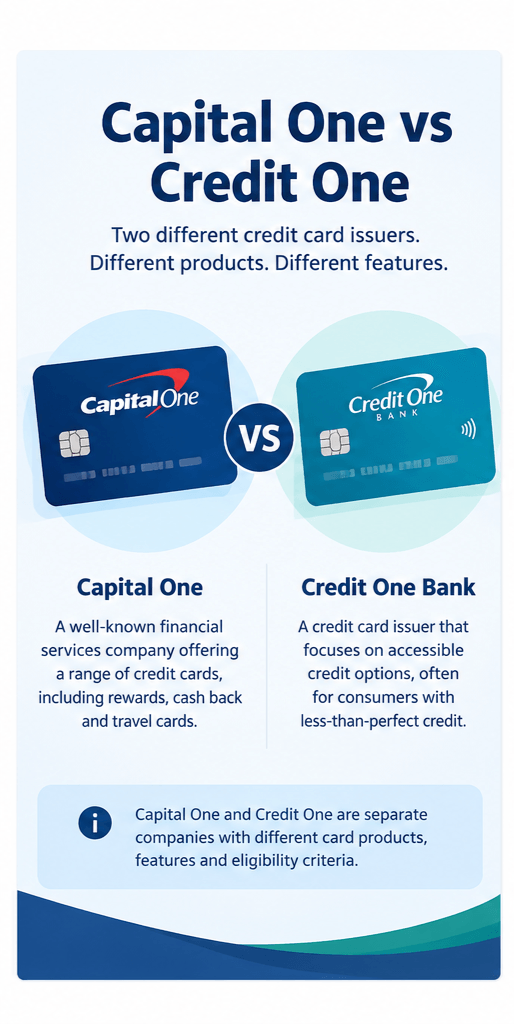
Quick answer: Capital One and Credit One are two completely separate, unaffiliated financial institutions that happen to share a similar-sounding name and a similar blue-and-white logo style. Capital One is a top-10 U.S. bank with more than 100 million customers, full banking services, and a card portfolio spanning secured cards to premium travel rewards. Credit One Bank, N.A. is a much smaller, FDIC-insured bank that issues credit cards only — no checking, no savings — and focuses primarily on unsecured cards for consumers with limited, average, or rebuilding credit. The meaningful comparison isn't "which company is bigger" (Capital One, clearly) — it's how their actual card products differ for someone deciding between them: fees, APR, secured-card availability, rewards, and prequalification.
Both issuers serve overlapping parts of the credit spectrum, which is exactly why the two get confused. This page compares them directly, card family to card family, so you can see where they genuinely overlap and where they don't.
Capital One vs Credit One at a Glance
| Feature | Capital One | Credit One Bank |
|---|---|---|
| Company type | Full-service national bank (checking, savings, loans, cards) | FDIC-insured bank focused on credit cards and CDs — no checking or savings |
| Approximate customer base | 100 million+ across all products | Roughly 12–15 million cardholders (smaller, credit-card-only base) |
| Card portfolio breadth | Secured, starter unsecured, cash back, travel, and business cards | Unsecured Platinum-branded Visa cards only, across a narrower credit range |
| Secured card offered? | Yes — Platinum Secured and Quicksilver Secured, refundable deposit | No — every current Credit One card is unsecured |
| Reports to 3 credit bureaus | Yes | Yes |
| Foreign transaction fee (relevant cards) | $0 on its fair-credit and secured cards | Up to 3% |
| Balance transfers | Offered (with a transfer fee) | Not offered |
| Corporate relationship | None. Capital One does not own Credit One, and vice versa — they are independently owned and operated. | |
Are Capital One and Credit One the Same Company?
No. This is worth stating plainly because the confusion is common and understandable: the names are one word apart, both logos use a similar blue color scheme and a simplified wordmark, and both issue cards to overlapping parts of the credit spectrum. But they are separate, independently owned institutions with no shared ownership, no shared underwriting, and no shared card products.
Capital One Financial Corporation is a Fortune 500 bank ranking among the largest U.S. banks by deposits, offering checking and savings accounts, auto loans, business banking, and a full range of credit cards from secured starter products to premium travel cards.
Credit One Bank, N.A. is a Las Vegas–headquartered, FDIC-insured national bank that issues its own Platinum-branded Visa cards directly — it doesn't rely on a third-party servicer the way some other subprime-market cards do — but its business is narrower: credit cards and CDs, with no checking or savings products, and a card lineup concentrated on consumers with limited, average, or rebuilding credit.
Because underwriting, fees, APR, and rewards are set independently by each bank, a Credit One card and a Capital One card marketed to a similar credit tier can still have meaningfully different costs. Approval by one issuer says nothing about your odds with the other.
Capital One vs Credit One: Key Differences
The differences that matter most for a consumer choosing between them come down to a handful of structural facts, not brand reputation alone:
Product breadth. Capital One's card lineup spans secured cards, no-fee starter unsecured cards, rewards cards, and premium travel products. Credit One's lineup is narrower — Platinum-branded unsecured Visa cards positioned from "rebuilding credit" up through "average-to-excellent credit," with no secured, no travel, and no business card options.
Secured-card access. Capital One offers genuine $0-annual-fee secured cards with a refundable deposit as low as $49–$200. Credit One has no secured product at all — every Credit One card skips the deposit in exchange for an annual fee instead.
Fee structure at the entry tier. Capital One's fair-credit and secured cards (Platinum, Platinum Secured) charge $0 annual fee. Credit One's flagship credit-building card, the Platinum Visa® for Rebuilding Credit, charges $75 the first year and $99 annually after that.
Foreign transaction fees. $0 on Capital One's relevant cards versus up to 3% on Credit One's cards.
Balance transfers. Available on Capital One cards (for a fee); not offered on any current Credit One card.
Rewards at the no-fee tier. This is a genuine nuance in Credit One's favor: its Platinum Rewards Visa® with No Annual Fee earns modest category-based cash back at $0 cost, while Capital One's comparable no-fee unsecured card (the Platinum Credit Card) earns no rewards at all.
APR. Both run in a similar high-20s range for their fair-credit and rebuilding-credit products — this is one dimension where the two issuers are closely matched rather than clearly differentiated.
Capital One Credit Cards Relevant to This Comparison
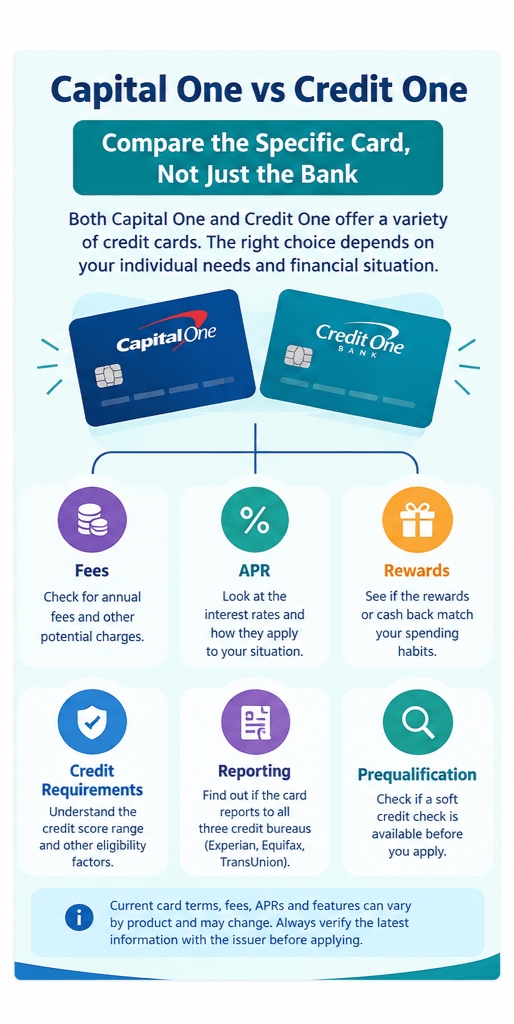
Capital One's full catalog is large, but only a handful of its cards sit in the same credit tiers Credit One targets. The three worth knowing for this comparison:
Capital One Platinum Secured Credit Card — $0 annual fee, a refundable security deposit of $49, $99, or $200 (all yielding at least a $200 starting credit line), no rewards, no foreign transaction fee, and an automatic review for a credit-line increase after about six months, with a documented path to upgrade to an unsecured card and get the deposit back.
Capital One Platinum Credit Card — the unsecured counterpart, marketed to limited or fair credit, $0 annual fee, no rewards, no foreign transaction fee, same automatic credit-line-increase review.
Capital One QuicksilverOne Cash Rewards Credit Card — for fair credit (commonly cited around a 630–689 range), $39 annual fee, unlimited 1.5% cash back on purchases plus 5% on hotels, vacation rentals, and rental cars booked through Capital One Travel.
This isn't a full Capital One review — for cards outside these tiers (travel-rewards products like Venture, or premium cash-back cards like SavorOne at the full-rewards level), an independent Capital One-specific review is a better resource than this comparison page.
Credit One Credit Cards Relevant to This Comparison
This site already covers Credit One in depth in a dedicated Credit One Bank Credit Card Review, so this section stays narrow — just the facts needed to compare against Capital One:
Platinum Visa® for Rebuilding Credit — Credit One's flagship product, $75 the first year then $99 annually (billed $8.25/month), a variable purchase APR that issuer disclosures put around 29.74% (independent sources report a 25.49%–29.74% range by creditworthiness), a typical $300 starting limit, and 1% cash back limited to gas, grocery, and internet/cable/mobile-phone purchases.
Platinum Rewards Visa® — $39 annual fee, same category-based 1% rewards structure.
Platinum Rewards Visa® with No Annual Fee — $0 annual fee, same category-based 1% rewards structure — Credit One's only $0-fee product.
All three are unsecured, all report monthly to Experian, Equifax, and TransUnion, none offers balance transfers, and all carry a foreign transaction fee of up to 3%. For the full fee breakdown, APR sourcing, and complaint history, see the dedicated review linked above rather than this page re-deriving it.
Capital One vs Credit One for Bad Credit
Neither issuer publishes a guaranteed approval score, and approval always depends on more than a single number — see this site's guide to what credit score you need for a credit card for how issuers weigh score against income, debt, and history generally. What differs between the two issuers for this specific audience is structural, not just approval odds:
Capital One's answer to bad or no credit is a secured card. The Platinum Secured and Quicksilver Secured cards accept a refundable deposit as low as $49 and don't charge an annual fee — meaning the only upfront cost is a deposit you get back, not a fee you don't.
Credit One's answer to bad or thin credit is a fee-funded unsecured card. There's no deposit to put down, but the trade-off is a real annual cost ($75 in year one, $99 after) taken directly out of an already modest credit line.
Neither structure is universally better — it depends on whether you have deposit funds available. If you can set aside even $49–$200 temporarily, a Capital One secured card is very likely the lower-cost path to the same credit-building outcome, since the deposit comes back and there's no annual fee eroding it. If you genuinely cannot access deposit funds, Credit One's unsecured, fee-funded structure gets you a reporting tradeline without that upfront cash requirement — at the cost of an ongoing fee a secured card wouldn't charge. This site's broader best credit cards for bad credit guide and secured vs. unsecured credit cards explainer cover this deposit-vs-fee trade-off in full depth across the whole market, not just these two issuers.
Neither issuer guarantees approval, and this isn't a promise that either card is easy to get — only a comparison of what each structure costs if you're approved.
Capital One vs Credit One Fees
| Fee | Capital One (relevant cards) | Credit One (all current cards) |
|---|---|---|
| Annual fee — secured/no-fee tier | $0 (Platinum Secured, Platinum unsecured) | $0 (Platinum Rewards Visa with No Annual Fee only) |
| Annual fee — rewards tier | $39 (QuicksilverOne) | $39 (Platinum Rewards Visa) or $75/$99 (Rebuilding Credit) |
| Monthly fee | None on relevant cards | Rebuilding Credit fee is billed monthly ($8.25) but is the same annual total, not an extra charge |
| Foreign transaction fee | $0 | Up to 3% |
| Balance transfer fee | $0 at transfer APR, or 4% at a promotional APR (where offered) | Not applicable — balance transfers not offered |
| Security deposit | $49–$200, refundable, on secured cards only | None — no secured product exists |
Exact fees, APR, and offers vary by the specific product and your individual creditworthiness on both sides — confirm your own pre-qualified terms directly with each issuer before applying.
Capital One vs Credit One Rewards
| Card | Annual Fee | Rewards |
|---|---|---|
| Capital One Platinum Secured / Platinum | $0 | None |
| Capital One QuicksilverOne | $39 | Unlimited 1.5% on all purchases, plus 5% on hotels/rental cars/vacation rentals via Capital One Travel |
| Credit One Rebuilding Credit / Platinum Rewards | $0–$99 | 1% cash back, limited to gas, grocery, and internet/cable/mobile categories only |
| Credit One Platinum Rewards No Annual Fee | $0 | Same 1% category rewards, at no cost |
Two things stand out here rather than a single "winner." First, at the $39-fee tier, Capital One's QuicksilverOne earns a meaningfully broader and higher rate (1.5% on everything) than Credit One's category-limited 1%. Second, at the $0-fee tier specifically, Credit One's Platinum Rewards Visa with No Annual Fee earns modest rewards where Capital One's comparable no-fee card (Platinum) earns none at all — a genuine point in Credit One's favor for someone who wants any rewards without paying an annual fee and doesn't want to put down a secured deposit.
Capital One vs Credit One for Building or Rebuilding Credit
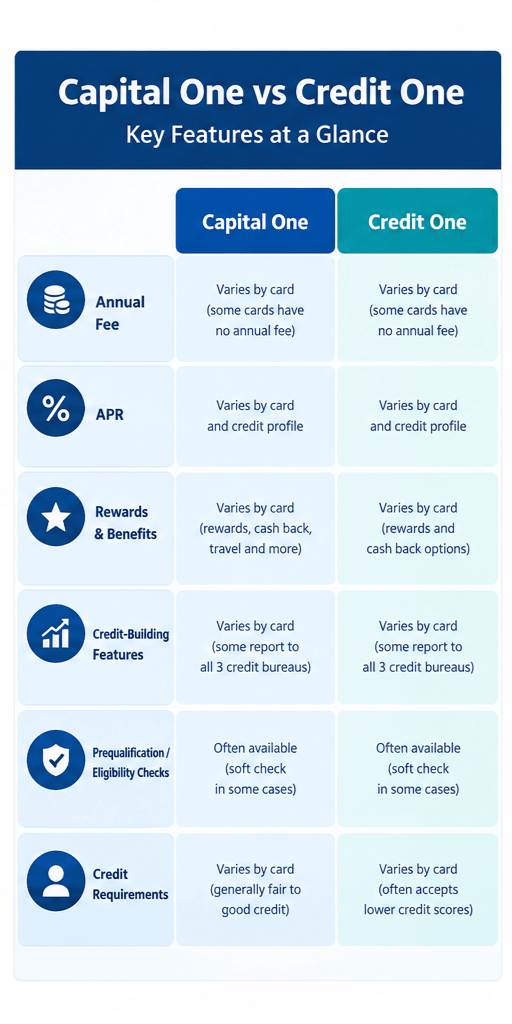
Both issuers report monthly to all three major credit bureaus, and reporting — not the brand name on the card — is what actually lets an account contribute to a credit history. For the underlying mechanics of how payment history and utilization move a score, see this site's how credit cards build credit guide rather than this page re-deriving that math.
Where the two issuers differ for this specific purpose:
Capital One's secured cards let you control your starting credit line by choosing your deposit amount ($49, $99, or $200, all yielding a $200 minimum line) — and because the deposit comes back on account closure or upgrade, the multi-year cost of building credit this way is close to zero if you pay in full.
Credit One's fee-funded structure has a real, non-refundable annual cost ($75–$99 on its flagship product) that a secured card doesn't carry, though it avoids the need to set aside deposit cash upfront.
Capital One documents an explicit upgrade path from secured to unsecured status with the deposit refunded. Credit One describes account reviews for credit-limit increases on its Rebuilding Credit card, but — as this site's Credit One review notes — no fixed increase schedule or product-upgrade guarantee is published.
Neither path guarantees a specific score outcome; that depends on payment history and utilization, not on which issuer's name is on the card. This section stays intentionally narrow — for the full credit-building framework, deposit-vs-fee math across the wider market, and how many accounts to consider opening, see best credit cards to build credit and how credit cards build credit.
Capital One vs Credit One: Prequalification
Both issuers let you check likely terms before a formal application, using a process that typically relies on a soft credit inquiry that doesn't affect your score:
Capital One offers online pre-qualification tools ("see if you're approved") across its card lineup, including its secured and Platinum unsecured products.
Credit One offers its own prequalification tool that lets applicants check likely terms with a soft pull before submitting a formal, hard-inquiry application.
Neither tool guarantees final approval — a formal application still involves a hard inquiry and full underwriting, and final terms can differ from what a prequalification check suggested. For the broader mechanics of how prequalification and preapproval work across the market — including the difference between the two terms — see this site's best credit cards with preapproval guide.
Which Credit Profiles Do Their Cards Target?
| Credit Profile | Capital One Products Marketed Here | Credit One Products Marketed Here |
|---|---|---|
| Limited / no credit history | Platinum Secured (deposit-based, most accessible) | Not a primary focus — Credit One markets mainly to established, rebuilding, or average credit |
| Bad / rebuilding credit | Platinum Secured, Platinum unsecured | Platinum Visa for Rebuilding Credit (flagship product) |
| Fair credit | Platinum unsecured, QuicksilverOne, SavorOne (fair-credit version) | Platinum Rewards Visa, Platinum Rewards Visa No Annual Fee |
| Average to excellent credit | Broader mainstream and premium lineup (Venture, Savor, etc. — outside this comparison's scope) | Platinum X5 Visa Signature (richer rewards tier) |
Published score ranges are general marketing guidance, not a guarantee — both issuers weigh income, existing debt, and other underwriting factors beyond score alone. See this site's what credit score do you need for a credit card guide for how that mapping works across the broader market.
Capital One vs Credit One: Credit-Building and Prequalification Snapshot
| Factor | Capital One | Credit One |
|---|---|---|
| Reports to 3 bureaus | Yes | Yes (some individual reports of inconsistent bureau-by-bureau reporting) |
| Soft-pull prequalification | Yes | Yes |
| Automatic credit-line-increase review | Yes, commonly cited around 6 months | Described as regular account reviews; no fixed schedule published |
| Secured-to-unsecured upgrade path | Documented, with deposit refunded | Not applicable — no secured product to upgrade from |
| Refundable deposit option | Yes, $49–$200 | No |
What Should You Compare Before Applying?
Before choosing between a Capital One and a Credit One card — or any two cards in the same credit tier — run through this checklist:
Annual fee, including whether it's $0, a flat rate, or increases after year one.
APR, since both issuers' relevant cards run in a similar high-20s range that matters if you carry a balance.
Rewards, and whether they're broad (Capital One's QuicksilverOne) or category-limited (Credit One's Platinum Rewards).
Credit limit relative to your planned spending, and how it affects your utilization ratio.
Security deposit vs. fee, since this is the core structural difference between the two issuers.
Prequalification, using a soft-pull tool before a formal, hard-inquiry application.
Reporting, confirming monthly reporting to all three bureaus.
Foreign transaction fees, if you travel or spend internationally.
Late fees and any penalty terms, read directly from the current cardholder agreement.
Upgrade options, and whether the issuer documents a formal path or leaves it undefined.
Long-term cost, adding up fees over two to three years rather than comparing year-one terms alone.
Capital One vs Credit One: Common Mistakes
Assuming the two companies are related. They aren't — approval, denial, or account history with one issuer has no bearing on the other.
Comparing a Credit One rebuilding-credit card against Capital One's premium travel cards. That's not a fair comparison; compare against Capital One's own fair-credit and secured products instead.
Overlooking that Credit One has no secured option. Someone who could access a lower-cost secured card elsewhere may be comparing the wrong Credit One product against Capital One entirely.
Treating a $0 annual fee as automatically the better deal without checking rewards. Credit One's no-fee card earns modest rewards; Capital One's no-fee unsecured card earns none — the "cheaper" card isn't always the same as the "better value" card.
Ignoring the foreign transaction fee gap if international spending is a factor — a real, recurring cost difference between the two issuers.
Assuming either issuer guarantees approval based on a published score range — both weigh income, debt, and other underwriting factors beyond score alone.
Frequently Asked Questions
No. They are separate, independently owned and operated banks with no corporate relationship, despite similar names and logo styling.
No — Capital One is a much larger, full-service national bank; Credit One Bank, N.A. is a smaller, credit-card-focused bank with no checking or savings products.
Neither is universally better — it depends on the specific product and what you value. Capital One's secured cards cost less if you can access a refundable deposit; Credit One's no-fee rewards card offers modest cash back that Capital One's comparable no-fee card doesn't.
Approval odds depend on the specific card and your individual credit profile with each issuer, not a general rule — both market products across a similar range of limited, rebuilding, and fair credit.
Yes — its Platinum Secured and Platinum unsecured cards are specifically marketed to limited, no, or fair credit, with the secured option requiring only a refundable deposit as low as $49.
Credit One's Platinum Visa for Rebuilding Credit is its flagship product for this segment, but it charges an annual fee Capital One's comparable secured card doesn't — "better" depends on whether you can access a deposit.
Yes, in the same way any properly used, reporting account can — through on-time payments and reasonable utilization, not simply through having the account open.
Yes — its secured and Platinum unsecured cards report monthly to all three bureaus and are specifically marketed for this purpose.
Not on its relevant secured and Platinum unsecured cards ($0). Its rewards-tier card for fair credit, QuicksilverOne, charges $39.
It depends on the product: $0 on the Platinum Rewards Visa with No Annual Fee, $39 on the standard Platinum Rewards Visa, and $75 the first year ($99 after) on the Platinum Visa for Rebuilding Credit.
Final Verdict
Capital One and Credit One are not competing versions of the same product — they're structurally different approaches to serving overlapping parts of the credit spectrum. Capital One's core advantage for anyone who can access a refundable deposit is its secured-card lineup: no annual fee, and the deposit comes back. Credit One's core advantage is skipping the deposit requirement entirely, in exchange for an annual fee its comparable Capital One products don't charge — except at its own $0-fee tier, where it uniquely offers modest rewards Capital One's no-fee card doesn't match. Neither issuer is the universal winner; the right choice depends on whether you have deposit funds available, how much you value rewards versus a lower ongoing cost, and whether foreign transaction fees or balance transfers matter to your situation. Compare your own pre-qualified offer from each issuer directly, and confirm current fees and APR on the issuer's own site before applying, since terms can change.
Editorial independence: This comparison is based on publicly available issuer documentation and established financial publications as of September 2026. Card terms, fees, and APR vary by specific offer and applicant creditworthiness and change frequently — confirm current terms directly with each issuer before applying. This page does not present either issuer as universally superior, and does not guarantee approval or credit-score outcomes for either.